The State of Radio
Is Local Radio Dead?
You've heard the narrative. Radio is dead. Nobody listens anymore. Podcasts and Spotify killed it. The truth, as usual, is more interesting — and more encouraging — than the headline.
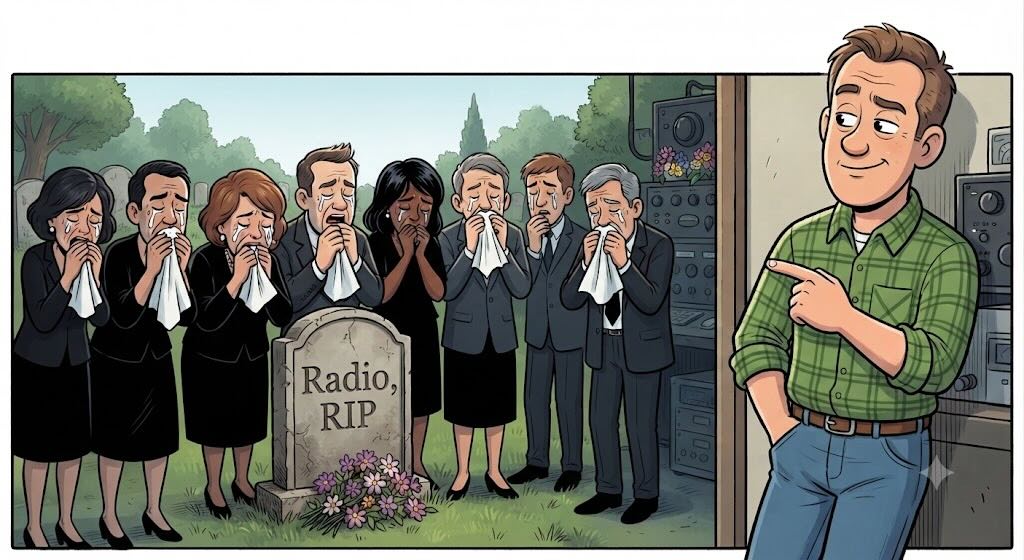
You've heard the narrative. Radio is dead. Nobody listens anymore. Podcasts and Spotify killed it. The truth, as usual, is more interesting — and more encouraging — than the headline.
If you only read tech blogs, you'd think radio disappeared sometime around 2015. The reality is startlingly different. According to Nielsen Audio and Edison Research's annual Infinite Dial study, AM/FM radio reaches approximately 82% of American adults every week. That's over 220 million people.
Let that number sink in. In a media landscape fractured into a thousand streaming services, social platforms, and podcast feeds, more than eight out of ten Americans still tune in to a radio signal every single week.
For context: Spotify has roughly 100 million US monthly users. Podcasts reach about 47% of Americans weekly, or approximately 135 million people. Radio still reaches nearly double the weekly audience of podcasts and more than double Spotify's monthly count. It's not even close.
So why does everyone think radio is dead? Because the people who write about media trends are, disproportionately, young, urban, tech-forward professionals who haven't turned on a radio in years. Their experience is real — but it's not representative. For the rest of the country — commuters, rural communities, small towns, people who work with their hands, people over 40 — radio is still part of the fabric of daily life.
Radio is not dead. But it is changing, and pretending otherwise would be dishonest. Here's the nuanced picture.
The number of people who listen to radio at least once a week has declined only a few percentage points over the past decade — from roughly 90% to 82%. That's a gradual erosion, not a collapse. Most people still encounter radio in a given week.
What has declined more noticeably is time spent listening. The average American who listens to radio has gone from about 14–15 hours per week a decade ago to roughly 10–12 hours now. People still tune in. They just don't leave it on as long. They switch between radio, streaming, and podcasts depending on context — radio in the car, Spotify at the gym, a podcast on the walk.
Approximately half of all in-car audio time is still AM/FM radio. This is down from 70%+ a decade ago, but radio remains the single largest source of audio in vehicles by a wide margin. Streaming accounts for roughly 20–25% of in-car audio, and podcasts about 5–8%.
The average American spends about 52 minutes per day in the car. For stations that serve commuters — which is most local stations — the morning and afternoon drive remains an enormous, captive audience that no streaming service has figured out how to take away.
Among adults 18–34, radio's position is more precarious. Streaming has overtaken radio in total listening time for this demographic, and podcasts are approaching parity. Younger listeners are less likely to have a habitual relationship with a specific station and more likely to move fluidly between audio sources.
This is the demographic that will determine radio's long-term trajectory. The stations that figure out how to be relevant to younger listeners — through local content, social media integration, streaming, and community engagement — will survive. The ones that don't will age out with their audience.
Total US radio advertising revenue is approximately $13–14 billion per year. That's down from a peak of about $20 billion in the mid-2000s, but it's still a substantial industry. Local and regional advertising accounts for roughly 75% of that total — meaning radio's financial foundation is not national campaigns but local businesses buying local airtime.
For small and medium-market stations, this is the most important number. Your advertisers are the car dealer, the bank, the restaurant, the insurance agent. They're not going to Spotify. They're not buying podcast ads. They want to reach people in their town, and radio still does that better than anything else for the price.
The "radio is dead" argument assumes that streaming and podcasts offer everything radio offers. They don't. Not even close. Here's what they're missing.
When the power goes out and the internet goes down, a battery-powered FM radio still works. Spotify doesn't. This isn't theoretical — it happens every severe weather season. FEMA and the FCC built the Emergency Alert System on radio infrastructure for a reason.
Spotify will never tell you the bridge on County Road 12 is closed. A podcast won't announce the water main break on Third Street. As local newspapers disappear, local radio stations are often the last remaining source of genuinely local information in their communities.
Algorithms curate. DJs connect. The voice on your local station lives in your town, knows the roads, knows the names, and reacts to what's happening right now. That's a fundamentally different experience than a playlist generated by a machine in San Francisco.
Everyone in town hears the same station at the same time. That shared experience creates community in a way that personalized, on-demand media never can. When the station announces that the football team won, the whole town knows at the same moment. There's power in that.
Radio requires no subscription, no account, no app, no update, no password, no WiFi, no cellular data. Turn it on. It's there. For billions of listening occasions every year, that simplicity wins.
The hardware store owner doesn't know how to buy a Spotify ad. He doesn't want to. He wants to call the station, talk to a person, and know that his message will reach people in his town. Radio's local sales model is its economic moat.
In an era of declining media trust, local radio holds a remarkable position. The Jacobs Media Techsurvey and Reuters Institute research consistently show that radio ranks among the most trusted media sources — ahead of social media by a wide margin and on par with local television.
Local radio specifically scores even higher. When the voice on the radio is someone you recognize, someone who lives in your community, someone who was on the air during the last ice storm giving you road conditions until midnight — that's trust you can't manufacture. National platforms are fighting a credibility crisis. Local radio, in many communities, has never lost it.
That trust is an asset that compounds over time. The station that's been reliably present, consistently local, and genuinely useful earns a relationship with its community that no amount of algorithmic optimization can replicate.
Here's a trend that should concern every community and encourage every local broadcaster: local newspapers are disappearing. Since 2005, the United States has lost roughly 2,500 newspapers — about a third of all the newspapers that existed. The rate has accelerated in recent years. Many communities that had a daily newspaper now have a weekly. Many that had a weekly now have nothing.
This creates what researchers call "news deserts" — communities with no local journalism at all. No one covering city council. No one at the school board meeting. No one reporting on local business openings and closings. No obituaries. No local sports coverage. The civic information that holds a community together simply stops flowing.
Into that void steps… what? Social media? Facebook groups are full of rumor and argument. National media? They don't know your zip code. Television? The nearest TV station is sixty miles away and does one small-town story a month.
Local radio is often the last locally operated media outlet standing. The last one with a live voice, a transmitter, and a reason to care about what happens in your town. That's not a burden. That's an opportunity that didn't exist twenty years ago when every town had a newspaper.
The stations that are thriving right now — not just surviving, but thriving — share a few common traits. None of them involve trying to out-Spotify Spotify.
This is the thesis of everything we've written on this site, and it bears repeating here. The stations that are growing are the ones that have committed, deeply, to being the community's information source, gathering place, and voice. Local news, community calendar, school sports, emergency information, events, people. Content that could only come from a station that lives here.
Spotify can match your playlist. It cannot match your presence at the county fair, your coverage of Friday night football, or your voice telling people which roads are passable during an ice storm. That's your moat. Widen it.
Streaming doesn't replace your terrestrial signal — it extends it to the people your tower can't reach. Alumni, commuters outside your coverage, people at work without a radio. When your budget supports it, a stream adds listeners without subtracting any. The grandfather in Arizona listening to his granddaughter's basketball game on your stream is a listener you never could have reached with FM alone.
The stations that struggle most are the ones where the operator is chained to the equipment — manually queuing songs, babysitting the board, troubleshooting unreliable software. That leaves no time for the community engagement that makes a station indispensable. Reliable automation frees the human to do the things only a human can do: make phone calls, attend events, interview neighbors, show up.
A signal that nobody sees is easy to forget. The station that shows up at the farmers market, sets up at the football game, broadcasts from the downtown festival, and puts its call letters on a banner in front of a card table — that's the station people remember, support, and defend when someone asks "does anyone still listen to radio?"
Not every demographic is equally reachable. Adults 35 and older are radio's strongest listeners. Families are radio listeners. Commuters are radio listeners. People in small and medium towns are radio listeners. These are not consolation demographics — they are the majority of the country, and they are the people local businesses want to reach. Serve them extraordinarily well before worrying about the 22-year-old who hasn't touched an FM dial since high school.
Here's the uncomfortable truth that the "radio is dead" conversation obscures: the biggest threat to local radio isn't technology. It's apathy.
The station that plays the same syndicated satellite feed that a hundred other stations play, that never mentions the name of the town it's licensed to, that has no local news, no community calendar, no presence at local events — that station should be worried. Not because of Spotify, but because it's given its listeners no reason to care whether it exists.
Spotify didn't kill those stations. They killed themselves by stopping doing the one thing nobody else can do.
The stations that are thriving are the ones that took the opposite path. They doubled down on local. They showed up. They became the voice of their community. They embraced old-school values that never went out of style. And they discovered something the tech industry doesn't understand: in a world of infinite choice, the thing people value most is the thing that belongs to them.
No. Not even close. But it is evolving, and the stations that evolve with it will be the ones still here in ten years.
The numbers are clear: over 220 million weekly listeners. Roughly half of all in-car audio. Higher trust ratings than almost any other media. An irreplaceable role in emergency communications. A financial model built on local advertising relationships that streaming services have no way to replicate.
What's dying is the version of radio that adds nothing to the community — the jukebox with a transmitter. What's alive and growing is the version of radio that leans in, shows up, and gives people something they can't get anywhere else: a local voice that knows their name.
If your station is willing to be that voice, the audience is there. It always has been. And it isn't going anywhere.
TuneTracker System 7 handles the automation so you can focus on being local. Free version available for macOS.
Download TuneTracker FreeContinue Reading
Practical guides for broadcasters who care about their craft and their community.