The One-Voice Problem
If you're the only person running your station, listeners hear your voice on the promos, the sweepers, the weather, the community calendar, and the live breaks. You might be great on the air. But after a while, a single voice creates a feeling — even a subconscious one — that the station is small and solitary. It sounds like one person talking to themselves.
Compare that to the station in the next market with three or four different voices cycling through. It sounds alive. It sounds like a place where things are happening. It sounds like a community, not a bedroom.
The good news: you don't need to hire anyone to get there. There are people all around you who would love to be part of your station — and technology that can fill in the rest. Here's how to build a roster of voices without building a payroll.
Invite People In
The most natural way to get more voices on the air is to put real people in front of a microphone. And the bar is much lower than people think. You're not asking someone to host a show. You're asking them to talk for sixty seconds about something they already know.
Community Contributors
Think about the people in your town who are already known and trusted. The high school coach. The library director. The county extension agent. The pastor at the biggest church. The manager of the food co-op. Each of these people has knowledge that your listeners would value — and most of them would be flattered to be asked.
The ask is simple: "Would you be willing to record a short recurring segment for the station once a week?" It doesn't have to be live. It doesn't have to be perfect. A two-minute recording about what's happening in their world, delivered however is most convenient for them, is all you need.
- The coach records a weekly game preview and recap during the season
- The library director records "What's New at the Library" every Monday
- The extension agent records seasonal gardening or farming tips
- The pastor records a weekly "Thought for the Day"
- The food co-op manager records what's fresh and local this week
Five contributors, each recording two minutes once a week, gives you ten segments — that's ten times during the week when a different voice comes through the speakers and your station sounds like a community talking to itself.
Make Recording Easy
The biggest barrier to community contributors isn't willingness. It's logistics. If recording means driving to your studio, finding parking, and sitting in front of unfamiliar equipment, most people will say yes once and never come back.
So make it effortless:
- Voice memo on their phone. The simplest approach. They record on their phone and text or email it to you. Modern phones produce perfectly usable audio. You can clean it up and level it in seconds with basic production software.
- A simple recording app. If you want slightly better quality, suggest a free app like Voice Record Pro (iOS) or Easy Voice Recorder (Android). Quick tutorial, and they're set.
- Come to them. Once a month, bring a portable recorder to the coach's office, the library, the extension office. Record a batch of segments in fifteen minutes. They never have to leave their desk.
- A standing studio appointment. For contributors who prefer coming in, set a fixed time — "Every Tuesday at 10am, the coach comes in and records." Routine removes friction.
The Voice Bank: Record Once, Use Many Times
Here's an idea that multiplies voices without multiplying anyone's workload. Invite local people to record a set of voice samples that you can use whenever you need them.
The concept is simple. You bring someone in — or visit them with a portable mic — and record them reading a handful of generic phrases and templates:
- "You're listening to [station name], your hometown station."
- "Stay tuned — we'll be right back."
- "Good morning! It's going to be a beautiful day in [town name]."
- "Support local. Shop local. Listen local."
- "Thanks for listening. We're glad you're here."
- "Coming up next on [station name]…"
- Community calendar intros: "Here's what's happening in [town name] today…"
- Weather intros: "Time for your local forecast…"
Record ten or fifteen of these with each person. Now you have a library of local voices you can drop into rotation for sweepers, bumpers, segment intros, and transitions. The retired teacher, the fire chief, the kid who won the science fair, the owner of the hardware store — all of them lending their voices to the station, even months after they recorded.
This does something powerful. When people hear their own voice — or their neighbor's voice — on the radio, the station stops being an abstract thing and becomes something they're personally connected to. The fire chief tells his whole department. The teacher tells her book club. The hardware store owner puts a sign in his window: "Listen for my voice on [station name]!"
AI Voices: Fill the Gaps Without Faking It
Let's talk about the elephant in the room. AI voice generation exists, it's gotten remarkably good, and it can solve a real problem for small stations: the content you need to produce every day that doesn't require a human touch, but still sounds terrible when you're the only voice reading it.
Weather forecasts. Public service announcements. Standard promos. Event listings. Traffic updates. These are informational segments that benefit from a clear, professional delivery but don't need personality or spontaneity. They just need to not sound like the same exhausted person reading copy for the fourteenth time today.
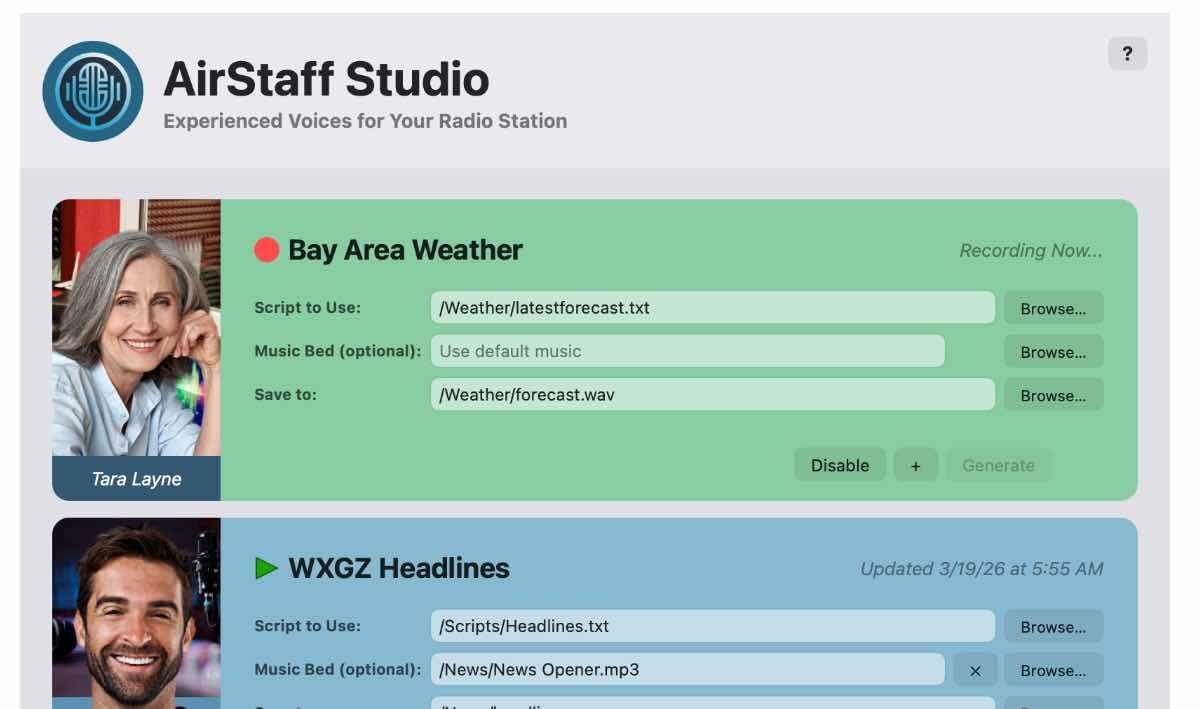
AirStaff Studio is built for exactly this. It gives you a roster of AI voices — warm, natural-sounding, broadcast-quality — that can read whatever you write. Weather copy. Community calendar listings. Promo scripts. PSAs. You type the text, choose a voice, and get a broadcast-ready audio file in seconds.
But here's the important part: AI voices don't replace your local voices. They supplement them. The coach still records the game preview in his own words. The library director still does her segment. The community contributor voices are irreplaceable precisely because they're real people from the community. AI fills in the utilitarian gaps — the segments where what matters is clear delivery of factual information, not personality.
Where AI Voices Work Best
Weather Forecasts
Updated multiple times a day. Nobody expects personality in a weather forecast — they expect accuracy and clarity. AI delivers both, consistently, without you re-recording every time the forecast changes.
Community Calendar Readings
You've got fifteen events to list. Reading them all in your own voice gets monotonous fast. An AI voice reads the calendar cleanly while your voice stays fresh for the live breaks and interviews that need your personality.
Public Service Announcements
Boil water advisories, road closures, vaccination clinic hours, shelter-in-place notices. Factual, time-sensitive, and better served by a clear, neutral delivery than by you trying to sound authoritative at 6am.
Overnight and Off-Hours
Your station runs 24/7 but you don't. AI-voiced top-of-hour IDs, weather updates, and promos during the overnight hours keep the station sounding staffed even when nobody's there.
And You're Not Limited to AI Voices
AirStaff Studio also lets you add your own local voices to the system. Record a sample from a real person, and AirStaff can use that voice to generate new content on demand. Imagine the mayor recording a ten-minute voice sample, and then using that voice throughout the year for civic announcements — even when the mayor doesn't have time to come in and record. The voice is genuine, local, and recognized. The convenience is modern.
This is where the voice bank concept meets AI: local people contribute their voice once, and the station can use it respectfully and practically whenever the need arises.
Remote Contributors: People Who Never Set Foot in Your Studio
Not every voice needs to originate from your studio. Some of your best contributors might be people who never visit at all.
The Phone Interview
The simplest remote contribution. Call someone, record the conversation, edit it lightly, and air it. A five-minute phone interview with the county commissioner about the new road project is a genuine news segment that took you ten minutes to produce. The audio quality won't be studio-grade, but listeners forgive phone quality when the content is real and local.
The Voice Memo Contributor
Set up a system where regular contributors send you voice memos on a schedule. The extension agent records Friday's farming report from his truck. The high school principal records Monday's "Week Ahead" from her office. The weather spotter records storm reports from the field. None of them ever come to your studio, and all of them add a voice to your air.
The Podcast-to-Radio Pipeline
Does anyone in your community produce a podcast? A local history buff, a cooking enthusiast, a sports commentator? Approach them about airing a segment from their podcast on your station. They get exposure to a broadcast audience. You get produced content with a different voice. Many podcasters will say yes instantly — it's free promotion for their show.
Student Reporters
High school and college journalism programs are full of students looking for experience. Invite them to submit reports — school news, event coverage, feature stories. Give them a format and a deadline, and you've got a pipeline of young voices that keeps the station sounding diverse and connected to the next generation. Some of the best community radio segments in the country are produced by teenagers who just needed someone to say "yes, you can be on the radio."
Putting It All Together
Here's what a station with this strategy sounds like over the course of a day:
- 6:00 AM — AI-voiced weather forecast, clear and current
- 6:15 AM — Your live morning break, warm and personal
- 7:00 AM — Top-of-hour ID read by the fire chief (voice bank recording)
- 7:30 AM — "Thought for the Day" recorded by the local pastor
- 8:00 AM — Community calendar read by an AI voice
- 9:00 AM — Station sweeper voiced by the hardware store owner
- 10:00 AM — Phone interview with the county commissioner about road construction
- 12:00 PM — "What's New at the Library" recorded by the library director
- 3:00 PM — Student reporter covering the school board meeting
- 5:00 PM — Coach's game preview for Friday's football game
- Overnight — AI-voiced weather updates and promos in rotation, all managed by AutoCast
That's at least eight different voices across the day. None of those people are on your payroll. Most of them recorded their segments in under five minutes. Several of them did it from their phone. And the station sounds like a living, breathing community hub — because it is one.
You're still the heart of the station. You're just not the only heartbeat anymore.
Tools that multiply your voices.
AirStaff Studio generates broadcast-quality AI voices — and lets you add local voices to the roster. AutoCast puts them all on the air, on schedule, automatically.
Learn About AirStaff Studio