The Quality Has Moved
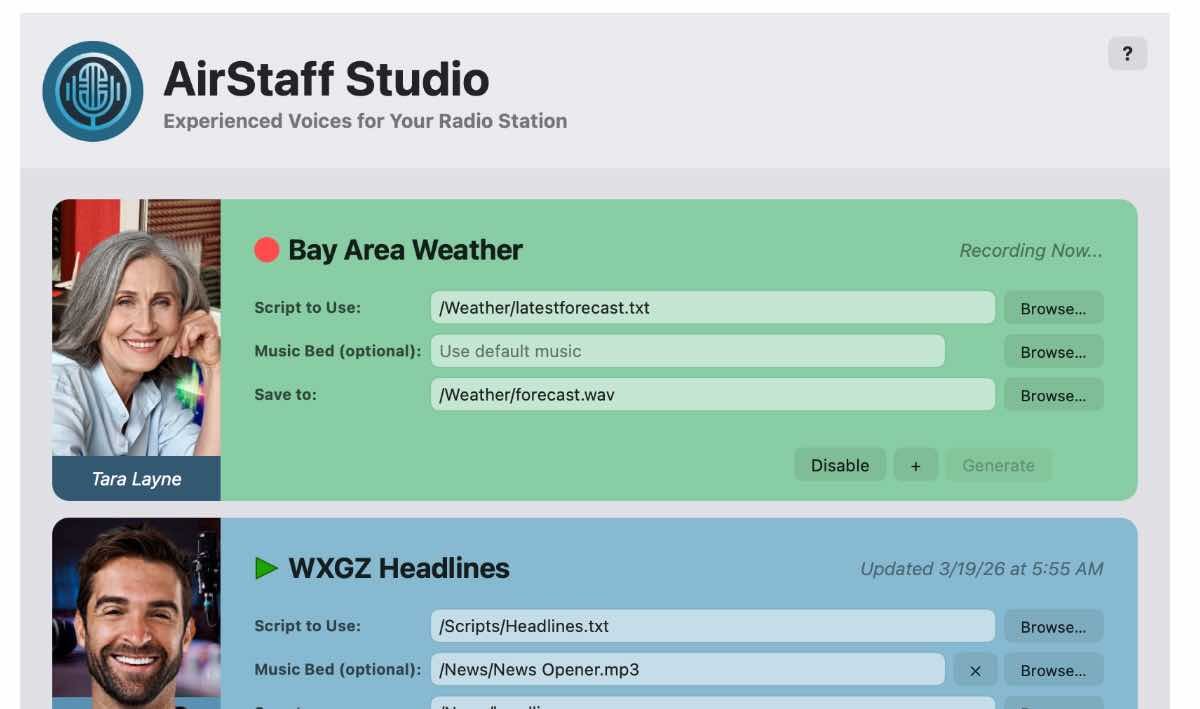
If you haven't listened to a current-generation AI voice in the last year or two, you're working with an out-of-date impression. The robotic-sounding text-to-speech voices most of us remember from GPS units and screen readers have been replaced by neural-network voices that — on the right script, in the right context — are indistinguishable from human voiceover work to the average listener. Inflection. Breath. Pauses. Emphasis. The new generation gets most of those right most of the time.
That changes the conversation. Three years ago, the question was whether AI voices were good enough for radio. They mostly weren't. Today the question is more interesting: where they belong, where they don't, and how to use them without undermining the part of the station that actually matters.
Where AI Voices Genuinely Help
There's a category of station content that is, by design, supposed to sound consistent rather than personal. Utility content. The same words, in the same order, hour after hour, day after day. Listeners aren't looking for a personality in this kind of audio — they're looking for the information. AI voices fit this work perfectly.
Utility Content
- Time and temperature checks. "Right now in Brookfield, it's 73 degrees, with sunny skies." Identical structure, varying numbers, fired hourly. Nobody is tuning in for the time-and-temp guy. AI handles this beautifully.
- Weather forecasts. Especially the regular shorter ones. The morning long-form forecast might still belong to a meteorologist; the :25 weather check doesn't have to.
- Sponsor reads for utility positions. The "weather brought to you by Smith's Hardware" stinger doesn't need a human voice.
- Brief news headlines and station information. "Coming up at the top of the hour, the latest from the council meeting." Bumpers and structural elements like this work fine with AI.
- Legal ID stingers. Some stations still want a live human voicing the legal ID; many use a recorded voice that fires automatically. Either way, the tone is formal and the content is fixed — AI works.
- School closings, lottery numbers, public service announcements. Dense informational content where consistency matters more than personality.
Things That Used to Be Out of Reach
This is where AI voices get genuinely interesting for small stations. There are kinds of content that small stations historically couldn't do at all because they didn't have the talent for them. AI puts those within reach.
- Multilingual broadcasts. A station serving a community with a substantial Spanish-speaking, Vietnamese-speaking, Hmong-speaking, or Somali-speaking population can produce content in those languages even without bilingual staff. The voice quality in major languages is now excellent.
- Overnight programming. A station that goes to automated music overnight can layer in voiced bumpers, weather updates, and ID elements without paying anyone to be in the building at 3 AM.
- Production-bed voiceovers and imaging. Sweeper VOs, podcast intros, promo beds. The production library expands considerably when the talent is on demand.
- Show prep scratch tracks. A producer can hear what a script sounds like at full pace before booking talent for the real recording. Quietly enormous for production efficiency.
For a small station with limited budget and limited staff, AI voices have done something the technology rarely does: made it possible to do more, not less.
Where AI Voices Hurt
Now the other side. There's an equally clear category of station content where AI voices cause more problems than they solve, and the stations that get into trouble with AI usually got into trouble by ignoring this list.
Anywhere Personality Is the Product
Morning shows. Personality-driven midday hosts. Talk shows. Interview formats. Anything where the listener is tuning in for the host as much as the content. AI voices can read words. They cannot be a person the audience comes to know and trust over years of listening, and any attempt to fake that is felt by the audience even when they can't articulate why.
Live Local Moments
The station's connection to its community lives in the moments where the voice on the air is unmistakably somebody who's actually here. A live shoutout to a local restaurant. A real reaction to last night's high school game. A casual aside about the weather that everyone in town actually noticed. These are the moments that make local radio local. An AI voice reading "the high school football team won last night" is technically correct and emotionally empty.
Sensitive Content
News about a local tragedy. A condolence. A correction. An apology. Anything that requires the audience to feel that a real human being is on the other end of the microphone. AI voices reading sensitive content doesn't just fall flat — it can come across as deeply wrong. The technology isn't the problem. The choice to use it in the wrong place is.
Anywhere Spontaneity Is Required
Live sports calls. Breaking news. Listener interactions. Live remotes. Anything where the script is being written in real time. AI voices need scripts; the moment the content has to react to the moment, AI is out of its depth.
What Listeners Can — and Can't — Tell
Here's the part that's evolved most quickly. A few years ago, listeners could spot an AI voice in two seconds. Today, with current-generation neural voices, the casual listener often can't distinguish AI from human at all on short utility content. Long-form content is harder to fake; over a sustained read, the small inconsistencies of pacing and inflection start to add up. But for a 15-second weather check or a 30-second sponsor read, the average listener cannot tell.
The tells that remain, even in good AI voices:
- Local pronunciations. An AI voice will mispronounce local street names, town names, family names — the things that immediately mark someone as not from here.
- Emphasis on key words. Humans naturally emphasize the words that carry meaning. AI voices sometimes emphasize the wrong word, or pace through a sentence without varying emphasis at all.
- Lists and dates. "Tuesday, May seventh, at six p.m." can land in slightly the wrong rhythm. Same for phone numbers, addresses, and price points.
- Emotional valence. The cheerful script read in a flat tone, or the sober script read with too much energy.
- Too consistent. Real humans vary. Their pacing changes. Their volume drifts. AI voices are sometimes too uniform, and the giveaway is the absence of normal human variation.
Most of these can be improved with care. Pronunciation guides for local names. Script tweaks to put emphasis where the AI will respect it. Mixing in human-recorded variants. The tools are getting better, and the gap is closing. For now, the people who notice the AI most are people in radio.
The Disclosure Question
Should stations tell listeners when a voice is AI-generated? The honest answer is that the industry hasn't settled on a norm yet. The FCC has not, as of this writing, set a general disclosure rule for AI voices outside of political advertising. Some stations disclose openly. Some make no mention. Some split the difference — "computer-generated weather sponsored by..." kind of language — that signals the synthetic origin without making a fuss about it.
Our own view: err on the side of transparency. Not because regulation requires it — it doesn't, mostly — but because listener trust is the only thing a small station has that the big ones can't out-spend. A station that gets caught running undisclosed AI voices in places listeners assumed were live talent loses some of that trust permanently. A station that uses AI openly, in clearly utility roles, doesn't.
Voice Cloning Is a Different Conversation
Worth separating: synthetic voices and voice cloning are two different things, and they raise different questions.
Synthetic voices are AI-generated voices that don't correspond to any specific real person — the voices that ship with services like ElevenLabs, OpenAI's TTS, Google's WaveNet, and others. They're generic in the same way a stock photography model is generic. There's no consent issue and no impersonation issue.
Voice cloning is taking a recording of a specific real person's voice and training an AI model to produce new audio in that voice. This is technically straightforward today — many of the same services offer voice cloning as a feature — and it raises real questions. With consent and compensation, voice cloning can be a legitimate tool: a regular voice talent who clones their own voice for show prep or vacation coverage, for example. Without consent, it's a legal and ethical minefield. Several states have already passed or are considering laws against unauthorized voice cloning. Federal legislation is on the way. Don't clone someone's voice without their explicit, written, ongoing permission.
A Practical Approach for Most Stations
For a small or mid-sized station weighing whether and how to use AI voices, here's a sensible path:
- Use AI voices for utility content. Time/temp, weather checks, sponsor reads on utility positions, school closings, brief structural elements. The places personality wasn't really part of the deal anyway.
- Use human voices for personality content. Hosts, interviews, talk segments, live local moments, anything where listeners are tuning in for who's at the microphone.
- Use AI to extend coverage, not replace presence. The station that used to go to dead-air automation overnight can now have a voiced overnight rig. The station that used to skip the weather break can now run one. Net new content, not displaced staff.
- Be transparent. Don't try to fool listeners. The trust dividend on small stations is worth more than the cost-savings dividend on undisclosed AI.
- Mix in real human voices wherever you can. The combination of AI utility content and human personality content sounds richer than either alone — and is a moat against the day when AI-only stations all start sounding the same.
The Bigger Picture
AI voices in radio aren't a replacement story. They're an augmentation story. The stations that do best with this technology are the ones that use it to do more — more languages, more dayparts covered, more utility content done well, more local programming made possible by freeing up staff from the work AI handles. The stations that get into trouble are the ones that try to use AI to fake what humans have always been better at: showing up, paying attention, and being unmistakably from here.
Used well, AI voices give small stations capabilities they couldn't afford a decade ago. Used badly, they erode the listener trust that makes a small station worth listening to in the first place. The technology doesn't make the choice. The station does.
For more on the broader question of how to add voices to a station — community contributors, voice banks, AI, and the rest — see our companion piece, More Voices on Your Station.
Whatever voices you put on the air, run them well.
TuneTracker is professional radio automation for the Mac — built to handle whatever audio you produce, however it was produced. Free version available, no time limit. Try it for yourself.
Download TuneTracker Free